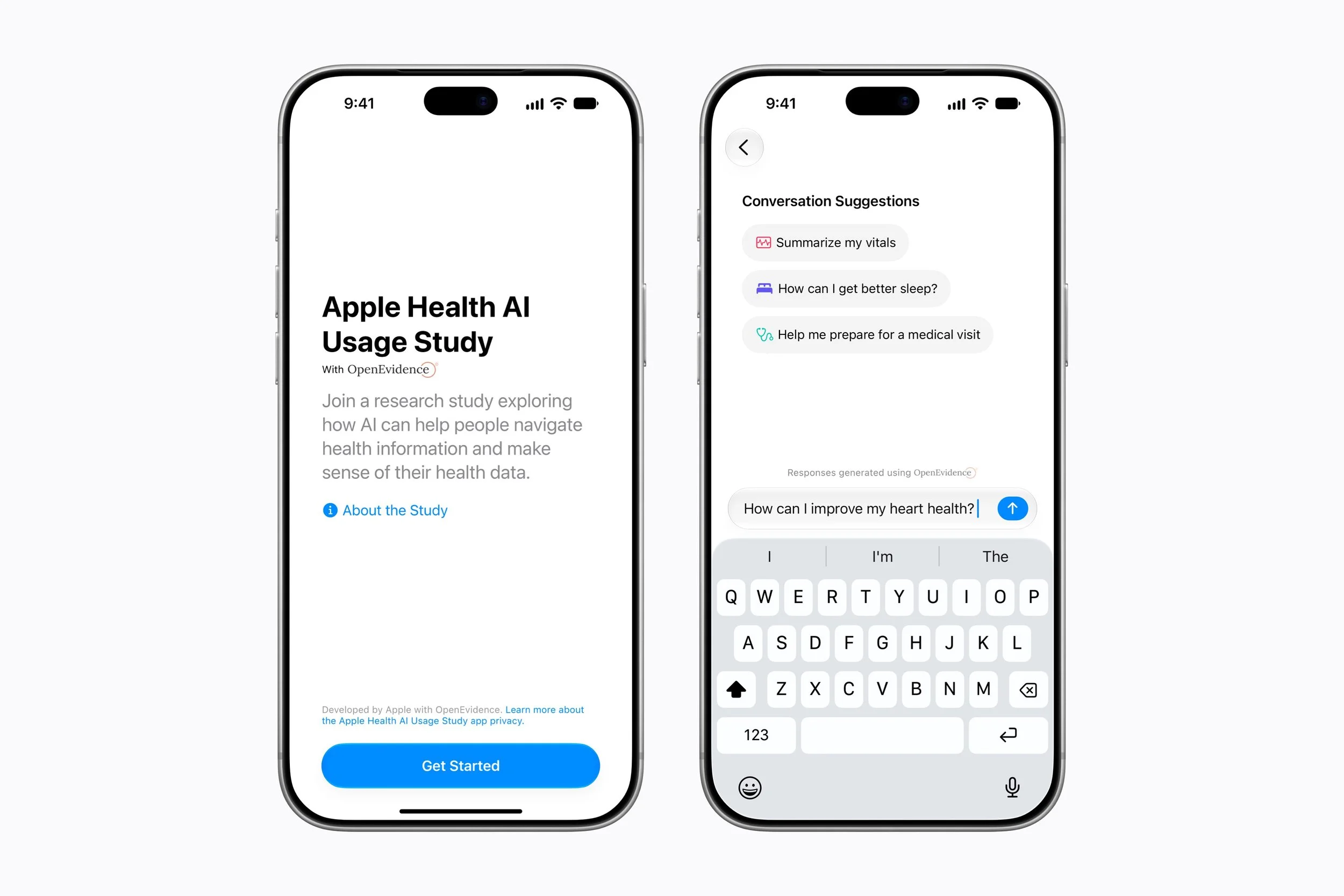
Apple wants up to 200,000 people to use a health AI study app, ask personal health questions, and choose whether to share data from Apple Health. Before you participate, you deserve a clear answer about how that information could be used and who could receive it.
Apple’s study announcement says study data will not be used to train AI models. The app’s App Store listing says the questions you ask support research that can help Apple make health AI “smarter for everyone.” Apple needs to explain, in plain language, how those statements fit together.
💡 Before you share your information
Check which Health data categories the study app asks to access.
Remember that the questions you type can reveal health information, too.
Read the study-specific consent form for data uses and recipients.
Ask which independent board reviewed the study and what it approved.
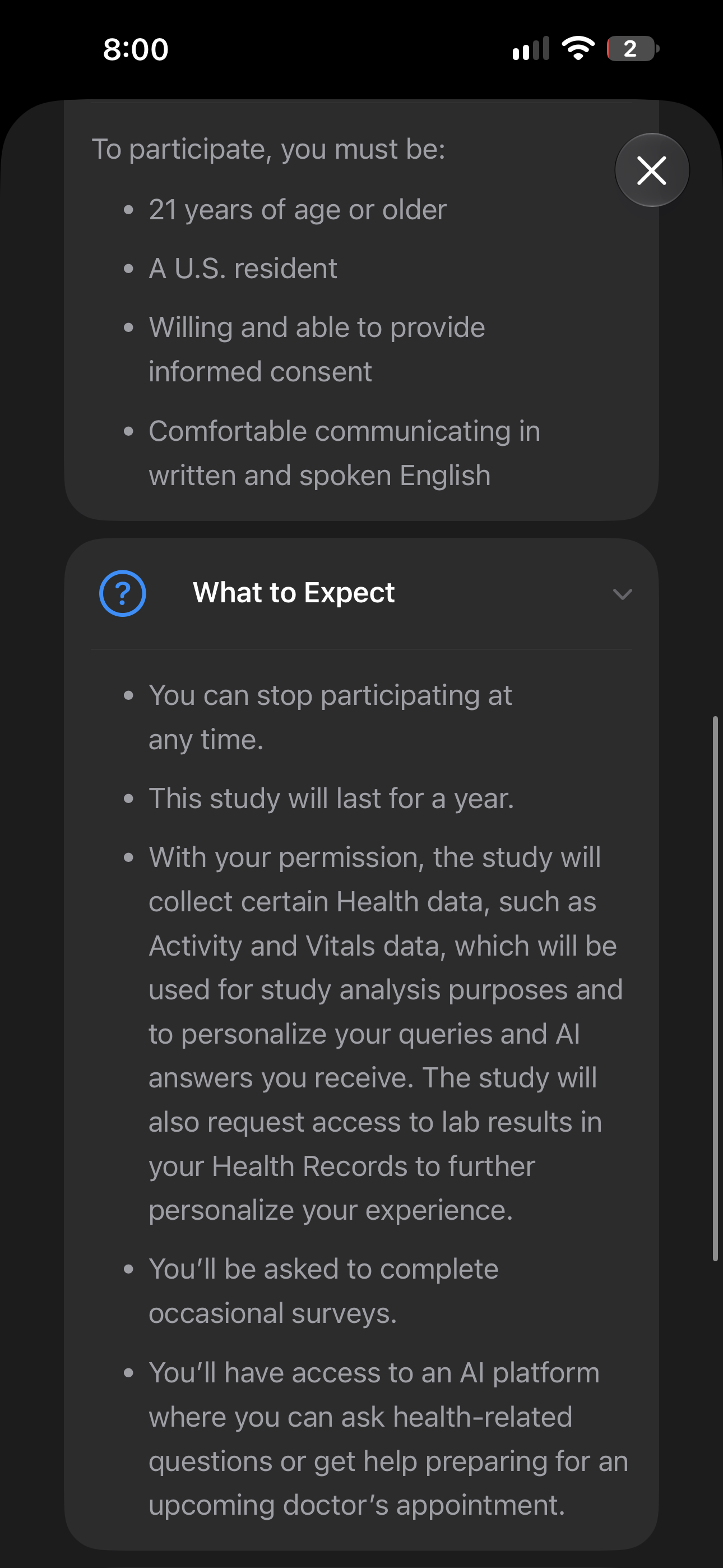
Apple’s study requirements and “What to Expect” screen.
What is the Apple Health AI Usage Study?
Apple announced the study on November 15, 2026, in collaboration with OpenEvidence, a company that provides an AI tool for healthcare professionals. Apple says the study will examine trust, the quality of answers, people’s understanding, and how they use health AI in daily life.
Participants can ask questions in a separate study app and choose whether to share Health data such as sleep, activity, resting heart rate, or lab results. The study is open to eligible U.S. adults age 21 and older with an Apple Intelligence-enabled iPhone running iOS 26 or later, according to Apple’s announcement.
The study app’s “What to Expect” screen says the study will last for 1 year. With your permission, it will collect certain Health data, including activity and vital signs, for study analysis and to personalize your questions and AI answers. The screen also says the study will request access to lab results in your Health Records and ask participants to complete occasional surveys.
The questions you type can contain sensitive information on their own. If you describe a lab result, a medicine, or a family member’s health, you’re sharing those details in the conversation even if you never connect your records.
The app’s eligibility screen also requires participants to be comfortable communicating in written and spoken English. That limits who can participate and should be considered when interpreting the study’s findings as it may inadvertently embed biases into the data.
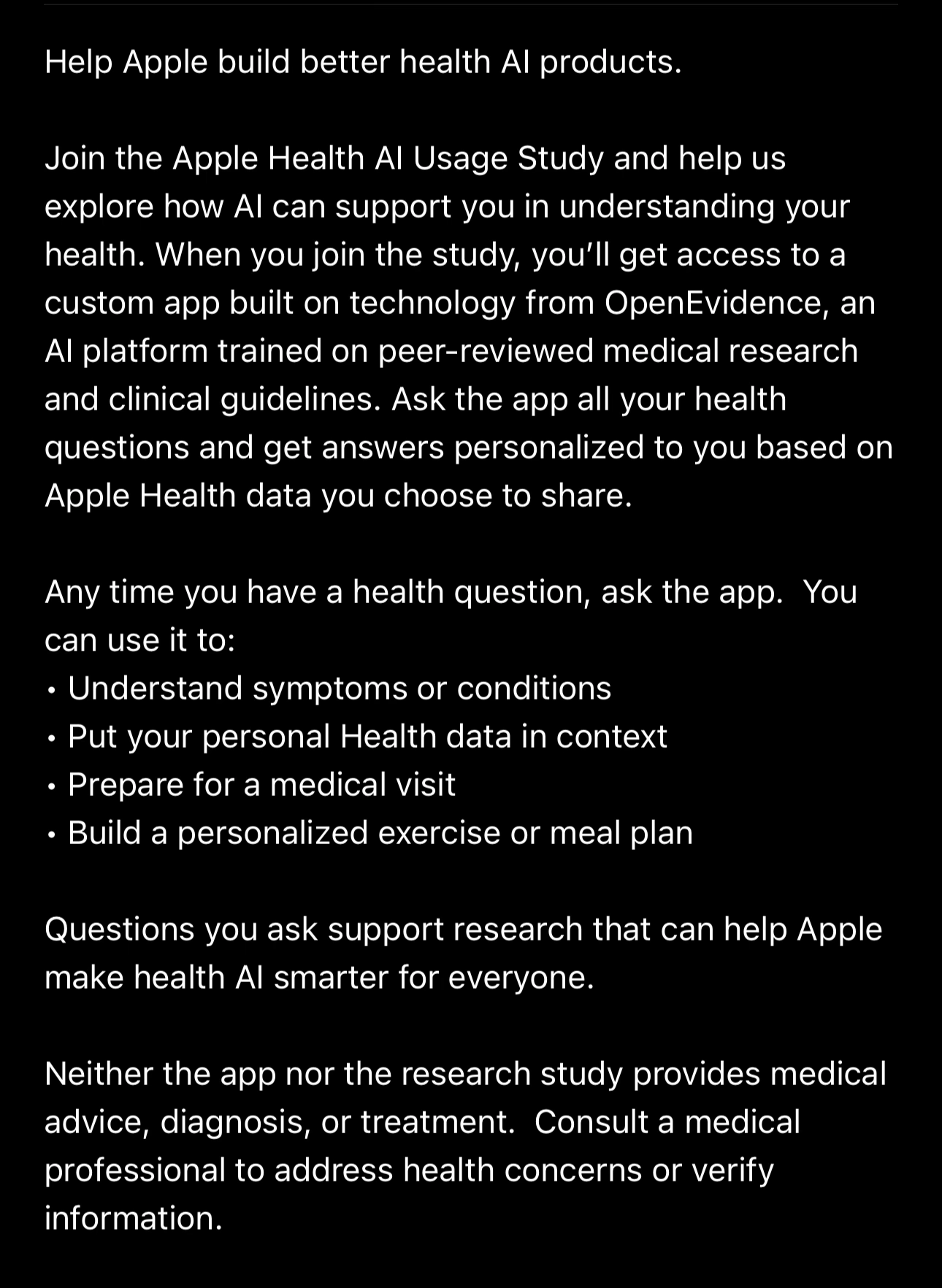
Apple’s App Store description says participants’ questions support health AI research.
Is Apple using study data to improve its health AI?
Apple’s public messages create an apparent inconsistency. The study announcement says, “study data will not be used to train AI models.” The App Store listing says, “Questions you ask support research that can help Apple make health AI smarter for everyone.”
Those claims can both be true. Training an AI model and studying how people use an app to improve a product are different activities. Apple has promised that study data won’t be used for the first, while saying participants’ questions will support research intended to help with the second.
Apple told ABC News that the research will inform its future products. Apple also said it plans to make the research broadly available to help the future of computer-assisted health communication.
That gives participants another reason to ask what happens to their information. Does Apple use individual questions or health data to develop products, or only research findings and summaries? Who can analyze the information, and for what purposes? Apple should explain what “smarter” means and how product development works without model training.
Apple’s plan to make research broadly available also needs more detail. Will it publish findings, share an aggregated dataset, or make other information available? With whom, and under what conditions? ABC’s report does not say Apple plans to share individual records or conversations.
What does Apple’s privacy policy allow?
Apple’s general Health Study Apps Privacy Policy says coded study data may be used for purposes described in a study’s consent form. The policy lists conducting research, developing health-related products, and improvement activities. It also describes possible use in other studies if the consent form permits it.
The policy says Apple and other study team members may share information with one another. Service providers may receive information for study-related work. Approved outside researchers may receive limited data if the consent form permits it. The policy also describes possible transfers in a reorganization, merger, or sale.
Those are terms in Apple’s general policy, not proof that each use or recipient applies to the Health AI Usage Study. The policy was last updated in 2020 and says the specific study’s consent form controls if the two conflict. I haven’t reviewed that study-specific form.
Apple says contact information is replaced with a code before the remaining study data reaches Apple systems. The policy says other study team members may keep data in a form that identifies participants. People deserve to know which organizations can access identifiable information and how they can use it.
What does OpenEvidence receive?
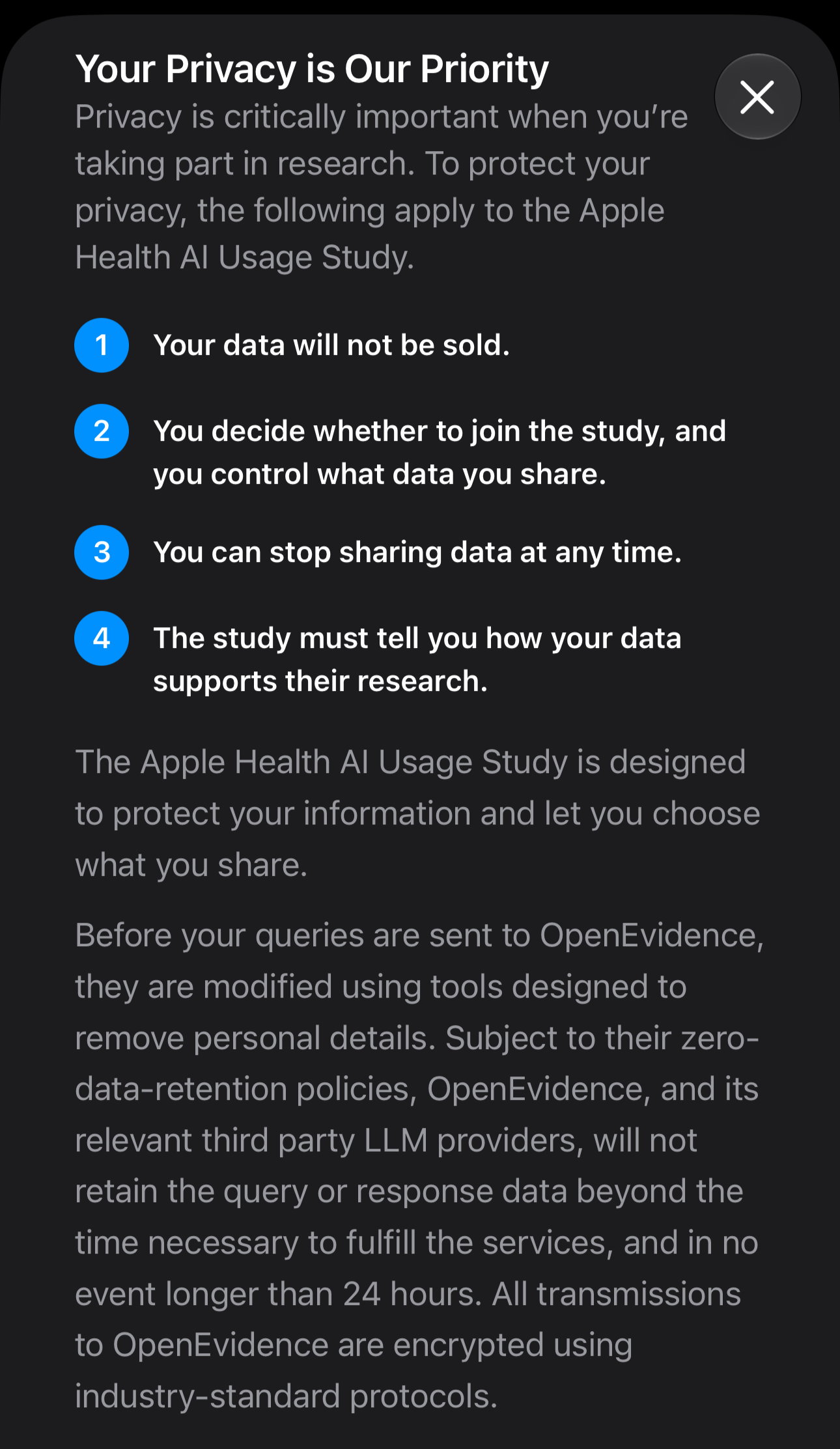
Apple’s in-app privacy screen describes its data-sharing and retention practices.
The study app’s privacy screen gives more detail than Apple’s public announcement. It says queries are modified using tools designed to remove personal details before they are sent to OpenEvidence. It also says transmissions to OpenEvidence are encrypted.
ABC News reported that Apple uses its own technology to turn medical research into easier-to-understand answers. Apple should explain what information its technology and OpenEvidence’s systems each process, and where that processing happens.
According to that screen, OpenEvidence and its relevant third-party large language model providers will not retain query or response data beyond the time needed to provide the service, and in no event longer than 24 hours, subject to their stated zero-data-retention policies. A large language model is the AI system that processes and generates text.
The screen says your data will not be sold. It also says information Apple collects through the study app is handled under its Health Study Apps Privacy Policy.
These are meaningful protections Apple describes. The screen does not name the third-party model providers or explain which personal details are removed. Tools designed to remove personal details do not, on their own, establish that every identifying detail is removed. The 24-hour limit applies to OpenEvidence and its relevant model providers’ query and response data. It does not establish how long Apple keeps study information for analysis.
Who is OpenEvidence connected to?
OpenEvidence’s connections reach into large health systems and the pharmaceutical industry. Those relationships deserve disclosure when Apple asks people to share personal health information with a study built on OpenEvidence technology.
Mayo Clinic: OpenEvidence lists Mayo Clinic as an investor. It does not list Mayo’s ownership percentage on that page.
Mount Sinai: In March 2026, Mount Sinai announced a collaboration to give clinical staff access to OpenEvidence within the health system’s electronic health record.
Northwestern Medicine: In October 2026, Northwestern Medicine and OpenEvidence announced a collaboration to put the tool into its electronic health record workflow.
Pharmaceutical advertisers: NBC News reported that ads from pharmaceutical companies and others funded OpenEvidence’s clinician-facing service. OpenEvidence says its advertising system is separate from its answers and that advertisers cannot influence the information it provides.
These connections do not establish that Mayo Clinic, those health systems, or advertisers receive Apple study data. Apple’s in-app privacy screen says modified queries are sent to OpenEvidence and describes a retention limit for queries and responses. Apple and OpenEvidence should also name the relevant third-party model providers and explain what information each receives and can use.
Has Apple worked with health insurers?
Apple has worked with major insurers on health and wellness programs. Those relationships are separate from the new study, and the sources below do not show that either insurer receives study data.
In 2019, Aetna, a CVS Health company, launched Attain with Apple. The app combined members’ health history with Apple Watch activity. Aetna later retired Attain at the end of 2023.
In 2021, UnitedHealthcare, part of UnitedHealth Group, expanded its work with Apple to offer eligible members a year of Apple Fitness+. It’s unclear whether that specific offer continues today.
Who oversees the Apple Health AI study?
Apple’s App Store guidelines require apps conducting health-related research with people to obtain approval from an independent ethics review board. Apple’s general health study policy also refers to an independent review board. I couldn’t verify the name of the board or its decision for this specific study from the public materials reviewed.
Apple should name the board, explain what it reviewed, and make the study’s data-use safeguards available to the public. The available information does not establish that the study lacks review.
Should the government set stronger rules?
Yes. Companies that collect health information for research should have to explain who can use it, for which purposes, and under what independent oversight. Those rules should also cover organizations that receive the information.
Federal protections already exist. The Federal Trade Commission says its rules against unfair or deceptive practices apply to most health app developers, including privacy and security claims. Certain health apps also have breach notification duties. Whether a particular rule applies depends on the app and its circumstances.
Lawmakers and regulators should require:
Public disclosure of data uses. Explain whether information can support product development or future research.
Named recipients and enforceable limits. Identify organizations that receive information and restrict use to the agreed purpose.
Independent review with public accountability. Name the ethics board and publish a plain-language summary of what it approved.
Meaningful consent. Explain each sharing choice before someone agrees to participate.
Audits and consequences. Give regulators the means to check compliance and act when companies break the rules.
These are proposals for stronger oversight. The available public materials do not establish that Apple has violated an existing rule.
How can you check Apple Health permissions?
Before granting access, review the categories the app requests. Apple’s Health data instructions explain how to find compatible apps. Menu names can vary by iOS version.
Open the Health app on your iPhone.
Tap your profile picture in the upper corner.
Under Privacy, tap Apps.
Select an app and review the categories it can access. Turn off categories you don’t want to share.
If the study app doesn’t appear, check its settings and the study instructions. Consider what you type into the app separately from the Health categories you connect.
What should you ask before joining?
Read the study-specific consent form and ask the study team for clear answers about the information already being collected and what each organization can do with it.
What questions, answers, survey responses, and health data are collected?
What information does Apple receive, and what details remain in the modified queries sent to OpenEvidence?
Which third-party model providers receive queries or responses, and what can each do with them?
How can individual questions, health data, or research findings be used to develop products?
What will Apple make broadly available: published findings, aggregated data, or other information? Who could receive it?
Can another organization use the information for research or another purpose?
Which ethics board reviewed the study, and how can I contact it?
People deserve a clear account of how their health information will be used before a company collects it.
If you want help understanding health information or preparing for a conversation with your care team, Leo is the AI health support tool inside ProjectLeo. Whatever app you choose, review its privacy policy and share only what you’re comfortable providing.
Leo provides health information and guidance, but does not replace professional medical advice, diagnosis, or treatment. Always consult with a qualified healthcare provider about your health concerns.